

Do you want to get your ears pierced or add a new piercing to your collection? Before you get started, it's best to know where to get pierced, how it works, how long healing takes, and what jewelry to wear afterwards. This guide answers all these questions, from the lobe to the cartilage.
Important note: at Marchand de Bijoux, we do not perform piercings. For the procedure itself, always go to a professional piercer. However, once your ear has healed properly, we will be delighted to help you choose your earrings.
The different ear piercing locations
The ear offers many locations. Each has its own name, style, and healing time.
| Name | Location | Estimated healing time |
|---|---|---|
| Lobe | The soft part at the bottom of the ear | 6 to 8 weeks |
| Second or third lobe | Above the first hole, always in the lobe | 6 to 10 weeks |
| Helix | The outer edge of the cartilage, at the top of the ear | 6 to 12 months |
| Flat | The flat part of the cartilage, below the helix | 6 to 12 months |
| Tragus | The small cartilage protrusion in front of the ear canal | 6 to 12 months |
| Conch | The central hollow of the ear | 6 to 12 months |
| Daith | The cartilage fold just above the ear canal | 6 to 12 months |
| Rook | The cartilage fold in the upper part, inside the ear | 6 to 12 months |
| Industrial | Two holes in the upper ear, connected by a bar | 9 to 12 months or more |
These times are estimates: they vary from person to person and depend heavily on the quality of care.
Lobe or cartilage: what's the difference?
The lobe is made of soft flesh: piercing it is quick, relatively painless, and heals in a few weeks. It is the ideal location for a first piercing.
The cartilage is harder and less vascularized. Piercing it is more sensitive, healing takes several months, and the area remains fragile to impacts, pressure, and friction throughout this time.
Pistol or needle: which method to choose?
- The pistol is quick and often used for the lobe. It pierces by pressure and directly inserts a piercing earring. It is not suitable for cartilage, as it can damage it.
- The needle, hollow, sterile, and single-use, pierces cleanly and limits trauma. It is the method preferred by professional piercers, and the only one suitable for cartilage.
Our advice: for the lobe, both methods are possible if hygiene is impeccable. For cartilage, always choose a professional piercer who uses a needle.
How does an ear piercing work?
- Choosing the studio. Check the cleanliness of the premises, the use of sterile single-use equipment, and the piercer's availability to answer your questions.
- Choosing the location. The piercer marks the spot with a marker and shows it to you in the mirror before starting.
- Disinfecting the skin.
- The piercing, which only takes a few seconds.
- Inserting the first piece of jewelry, suitable for healing.
- The aftercare instructions to follow during the following weeks.
For a child or teenager, the professional will ask for parental consent.
Does it hurt?
In the lobe, most people feel a brief pinch that is quickly forgotten. In cartilage, the sensation is more intense and the area remains sensitive for a few days. In any case, the pain is short: it is mainly the healing that requires patience.
Aftercare after an ear piercing
Good healing depends mostly on you. Here are the steps to follow.
- Wash your hands before touching your ear.
- Clean twice a day with physiological saline or a sterile saline solution, then pat dry with a clean compress.
- Do not twist the jewelry. This was common advice in the past, but piercers now advise against it: it irritates the wound.
- Avoid the pool, the sea, the sauna, and baths during the first few weeks.
- Do not sleep on the pierced side. For cartilage, a travel pillow helps protect the ear at night.
- Be careful of friction: hair, hats, headphones, phones, hair products, and perfume.
- Do not remove the jewelry before healing is complete. A recent hole can close very quickly.
What is normal
Slight redness, slight sensitivity, and a few clear crusts around the jewelry during the first few days are part of normal healing.
Signs that should alert you
- Redness that spreads or an area that feels hot to the touch
- Pain that increases after several days instead of decreasing
- Yellow or greenish discharge
- Significant swelling or fever
In this case, consult a doctor or your piercer without delay, and do not remove the jewelry yourself without their advice.
What materials for a first ear piercing?
The first piece of jewelry remains in the wound throughout healing: its material matters a great deal.
- Implant-grade titanium: lightweight, very well tolerated, it is the standard for professional piercers.
- Solid 14 or 18-karat gold: elegant and well tolerated, provided it is solid and not plated.
- Implant-grade surgical steel: a common and affordable alternative.
To be avoided for a fresh piercing: costume jewelry, plated jewelry, and silver, which can oxidize when in contact with a wound.
When and how to change your first earrings?
Wait at least 6 to 8 weeks for a lobe, and several months for cartilage, ideally with your piercer's approval. If the ear is still sensitive, be patient a little longer.

For your first earrings after healing, choose lightweight and securely closed models:
- Stud earrings, discreet and comfortable for everyday wear. Discover our stud earrings.
- Back-locking earrings, with their secure clasp, perfect for young ears. See our back-locking earrings.
- Small hoop earrings, once the hole is well established. Browse our hoop earrings.
Save dangle earrings and heavy models for later. And before wearing a new pair, whatever it may be, remember to disinfect the post.
Combination ideas
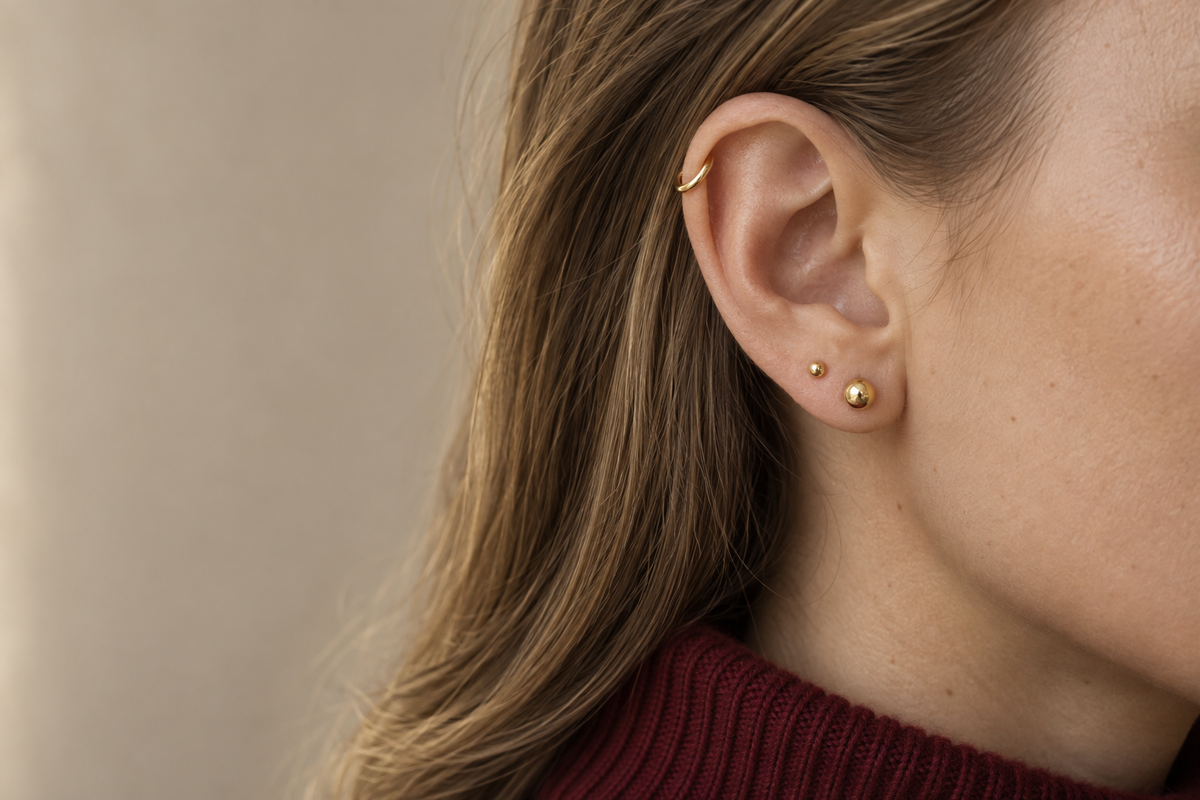
- Lobe and second lobe: two studs of different sizes, from largest to smallest.
- Lobe and helix: a thin hoop in the lobe and a small, discreet ring at the top of the ear.
- All gold: the same metal color throughout the ear for a harmonious effect. Take a look at our gold earrings.
Ear piercings for children
Many parents wait until the child is old enough to ask for it themselves and participate in the aftercare. For their first earrings, choose lightweight models without pendants, with a secure clasp: small screw-back studs or gold back-locking earrings. Discover our children's earrings.
And for men?
Male ear piercing is now very common, in both the lobe and cartilage. Simple studs and small rings remain the most popular choices. See our men's earrings.
How much does an ear piercing cost?
The price depends on the location, the method, and the jewelry inserted. A lobe piercing generally costs less than a cartilage piercing, and the price often includes the first piece of jewelry. Always ask for the full price before deciding, and never choose a studio solely for its price: hygiene comes first.
Frequently asked questions
How long does it take for an ear piercing to heal?
Generally, allow 6 to 8 weeks for the lobe and 6 to 12 months for cartilage, such as the helix, tragus, or conch. These times vary from person to person and depend on the quality of care.
When can you change your earrings after a piercing?
For a lobe, wait at least 6 to 8 weeks. For cartilage, you need to wait several months, ideally with your piercer's approval.
Can an ear hole close?
Yes. A recent piercing can close in a few hours without jewelry. An older piercing often stays open longer, but it can shrink.
What metal to choose for sensitive ears?
Implant-grade titanium and solid 18-karat gold are the best tolerated. Avoid costume jewelry and plated jewelry, which may contain nickel.
Find your next earrings
Is your ear healed? Browse all our earrings: each piece is unique, inspected, and refurbished in our workshop in Belgium. And for a gift, also discover our guide for choosing a piece of jewelry to give as a gift.


